


Daily Multivitamin & Mineral Complex for Men Capsules
Daily Multivitamin & Mineral Complex for Men Capsules
Regular price
R 145.00
Sale price
R 145.00
Regular price
Unit price
per
Servings: 30 | Price per serving: R 4.83
Tax included.
Shipping calculated at checkout.
Multivitamin & Mineral Complex supports energy, antioxidant protection, and overall nutritional balance daily.

[COUNT] shoppers are looking at this right now
🚚 Fast and Free Shipping
Free Shipping on all orders over R950!
🛡️ 7 Day Risk Free Refund
Shop risk-free with easy return.
Secure Checkout


100% Secure Checkout
Frequently Asked Questions
Men's formulations prioritise nutrients relevant to male health: higher B vitamins (energy metabolism and testosterone support), Zinc and Selenium (testosterone and prostate health), Vitamin D3 and K2 (testosterone and bone density), and often include Lycopene (prostate antioxidant). Men do not need supplemental iron unless anaemic.
Yes. After 40, testosterone decline accelerates, B12 absorption decreases, and the need for antioxidants for cellular protection increases. A high-potency men's formula with meaningful levels of Zinc, D3, Selenium, CoQ10, and B12 is more valuable than a basic low-potency product.
A comprehensive multi covers deficiency prevention across all essential vitamins and minerals. However, therapeutic doses of key supplements (Omega-3, Creatine, Magnesium Bisglycinate, Ashwagandha) typically exceed what a multi can include. Use the multi as your daily micronutrient base and add specific supplements for targeted goals.
Most men's multivitamins contain little to no iron. Men rarely experience iron deficiency (unlike menstruating women) and excessive iron is associated with oxidative stress and cardiovascular risk. This is an intentional formulation choice. If you need iron, your doctor will advise.
With breakfast or your main morning meal. Fat-soluble vitamins require dietary fat for absorption; B vitamins are energising and best taken in the morning; and stomach contents buffer any GI sensitivity. If the serving is 2 capsules, taking one morning and one midday splits the load for optimal absorption.


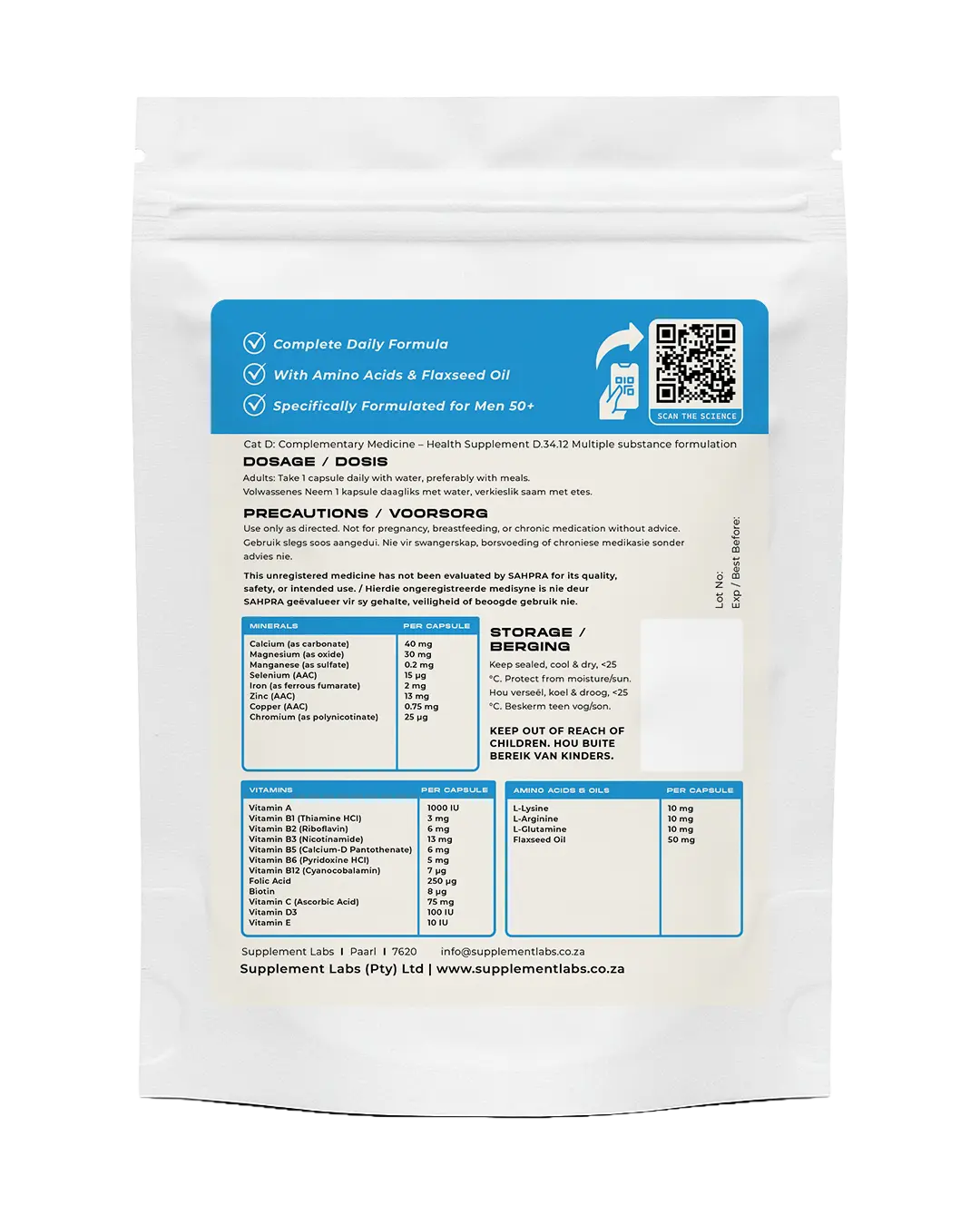
Product Specifications



Daily Multivitamin & Mineral Complex for Men Capsules
Regular price
R 145.00
Sale price
R 145.00
Regular price
Unit price
per


